One email, on the days a relationship needs you.
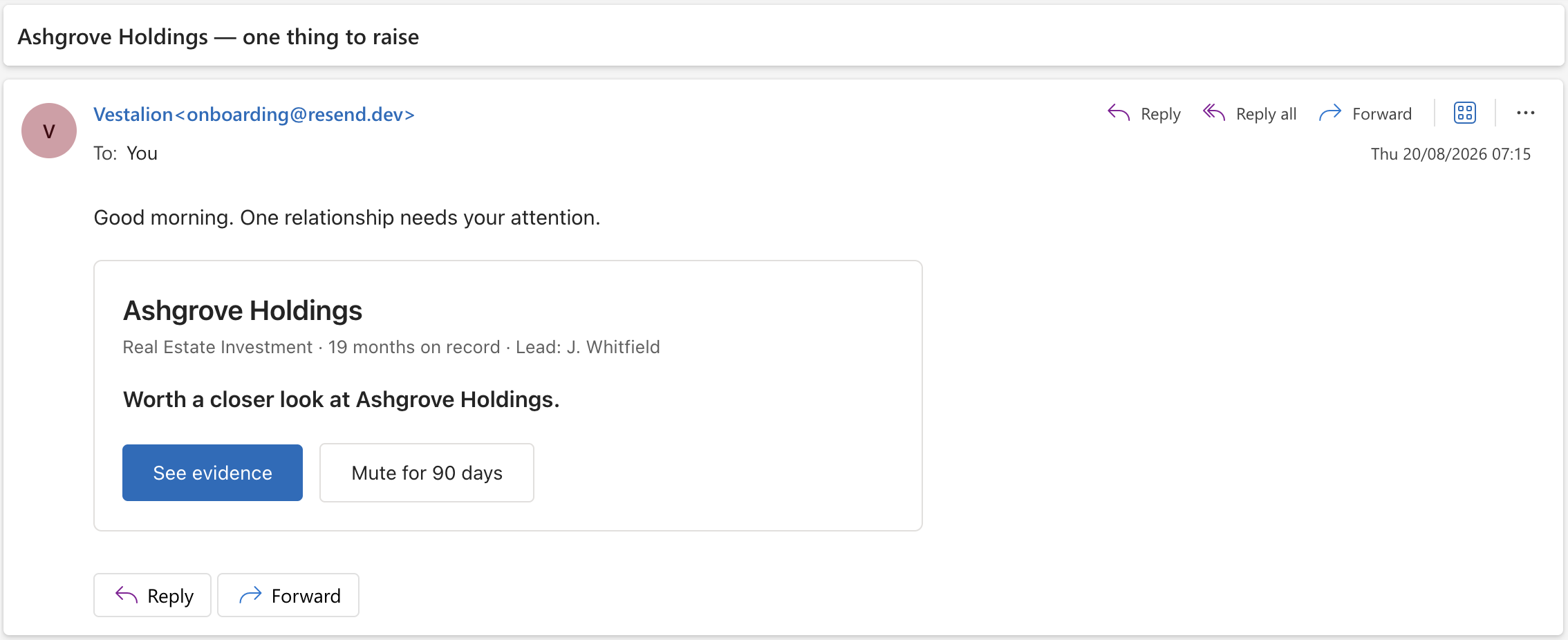

Illustrative example. Client names and figures are not real.
Attention is your scarcest asset. Spend it where it counts.
You find out which client relationship is quietly deteriorating while a conversation still fixes it.
The problem
Relationship drift starts long before it becomes noticeable.
Billing, payments, matter activity, and everything else that shows how a relationship’s actually going, none of it lives in one place. Pulling it together, one relationship at a time, is still done by hand, and only for the clients someone already thought to check. Early drift doesn’t put a client on that list. So the relationship that has quietly started to change keeps running as normal, and what would have taken one conversation ends up taking a write-off, a discount, or a pitch to win the work back. All the while, the client is deciding how much work to keep sending, and how many firms to keep sending it to.
95%
Losing clients
Firms reporting increased client attrition. It is happening almost everywhere, and it is getting worse, not better.
72%
Flying blind
Firms that don’t measure client churn at all. Their relationships drift with nothing tracking it.
1410
Shorter panels
Median number of firms a company uses, down by four in a single year. Clients are cutting, and someone is being cut.
The question you ask
Which relationship has changed in a way that deserves my attention?
It's the only question you need answered. Out of everything on your desk, has one relationship actually moved, and why. What the client does next, and what you do about it, stay yours.
Your job isn't reading reports. It's making calls, and protecting relationships worth protecting. The moment you have to pull four different reports just to work out whether a client is drifting, whatever's meant to help you has already failed.
How it works
From your firm's own data to one finding.
Nothing new for you to do
Billing, matters, invoices, all read straight from what the firm already has. You don't enter anything, and nothing changes about how you work today.
Judged on your relationship's own terms
What reaches you is judged in the context of that specific relationship.
You open one email
You read it on your phone or at your desk, and everything behind the finding is in there with it.
It comes to you
It lands in your inbox, only on the days one is warranted. No dashboard for you to remember to check.
What you won't see
Most days, there's nothing you need to know.
The silence is the finding: nothing needed your attention today, so you hear nothing.
You may already half-suspect a relationship is cooling. This puts evidence behind that hunch, gathered and ready before you have the conversation, on the days it's actually warranted.
What you can count on
What you won't get.
You get one clear finding on the days one is warranted.
What arrives is a finding with the evidence behind it, for you to weigh.
Every finding rests on a change in the record, something you can go and check.
Only patterns that clear a real bar for your attention reach you.
How your data is handled
What happens to your data.
Your billing and matter data is handled under strict access controls and used only for you.
Nothing of yours is sent to a third-party AI provider for analysis.
Ethical walls and access permissions are checked before a relationship is ever put in front of you, built to enforce your firm's own rules rather than work around them.
Come see which relationship needs you.
Questions
Frequently asked questions.
How Vestalion works
How does Vestalion know when a relationship needs attention?
Vestalion compares each client against their own history, not against a firm-wide average or other clients. It looks at billing patterns and engagement patterns over time and surfaces when something shifts from what’s normal for that specific relationship.
Does Vestalion predict which clients will leave?
No. Vestalion doesn’t predict departures and doesn’t claim to see the cause behind a shift. It surfaces that something in a relationship has changed and is worth a look. What’s happening and why is something only the partner can find out through a real conversation.
Does Vestalion tell me what to do about a relationship?
No. Vestalion ends at the evidence. It flags which relationship deserves a closer look and shows you what changed. It doesn’t suggest actions or next steps, that judgment stays with the partner.
What if we don’t have much history with a client yet?
Relationships without enough history are excluded from scoring rather than measured against a generic benchmark. Vestalion only makes a judgment when it has enough of that specific relationship’s own pattern to judge against.
Using Vestalion
What is the morning briefing?
A short, focused note delivered to your Outlook or Teams each morning, showing which relationship, if any, deserves your attention that day.
What happens if I mute a relationship?
Muting suppresses that relationship from your briefing for 90 days. It’s a personal setting, muting a relationship doesn’t change how Vestalion evaluates it for anyone else or feed back into the underlying model.
Why didn’t I get a briefing today?
Some mornings, nothing in your book of relationships has shifted enough to warrant a look. No news is the accurate result, not a gap in coverage.
How is this different from what my practice management system already shows?
Existing systems are built to manage information: matters, invoices, timelines. Vestalion is built to manage attention. It doesn’t replace those systems, it tells you which one thing in them is worth your time today.
Setup and trust
How does Vestalion connect to our existing systems?
Vestalion connects to your firm’s billing and matter data through a secure, read-only integration. If your firm runs a practice management platform, that connection is direct. If your billing data lives elsewhere, we set up a secure data feed with your finance or IT team instead. Briefings are delivered through Microsoft 365, straight into Outlook and Teams, no separate portal to check.
How long does implementation take?
Most firms are fully onboarded within six to ten weeks. Firms with billing data already centralized in one system move faster.
Is our client data secure?
Vestalion is built to meet the data protection standards of the US, UK, Ireland, Australia, and Canada, including UK and EU GDPR, Australia’s Privacy Act, and Canada’s PIPEDA.